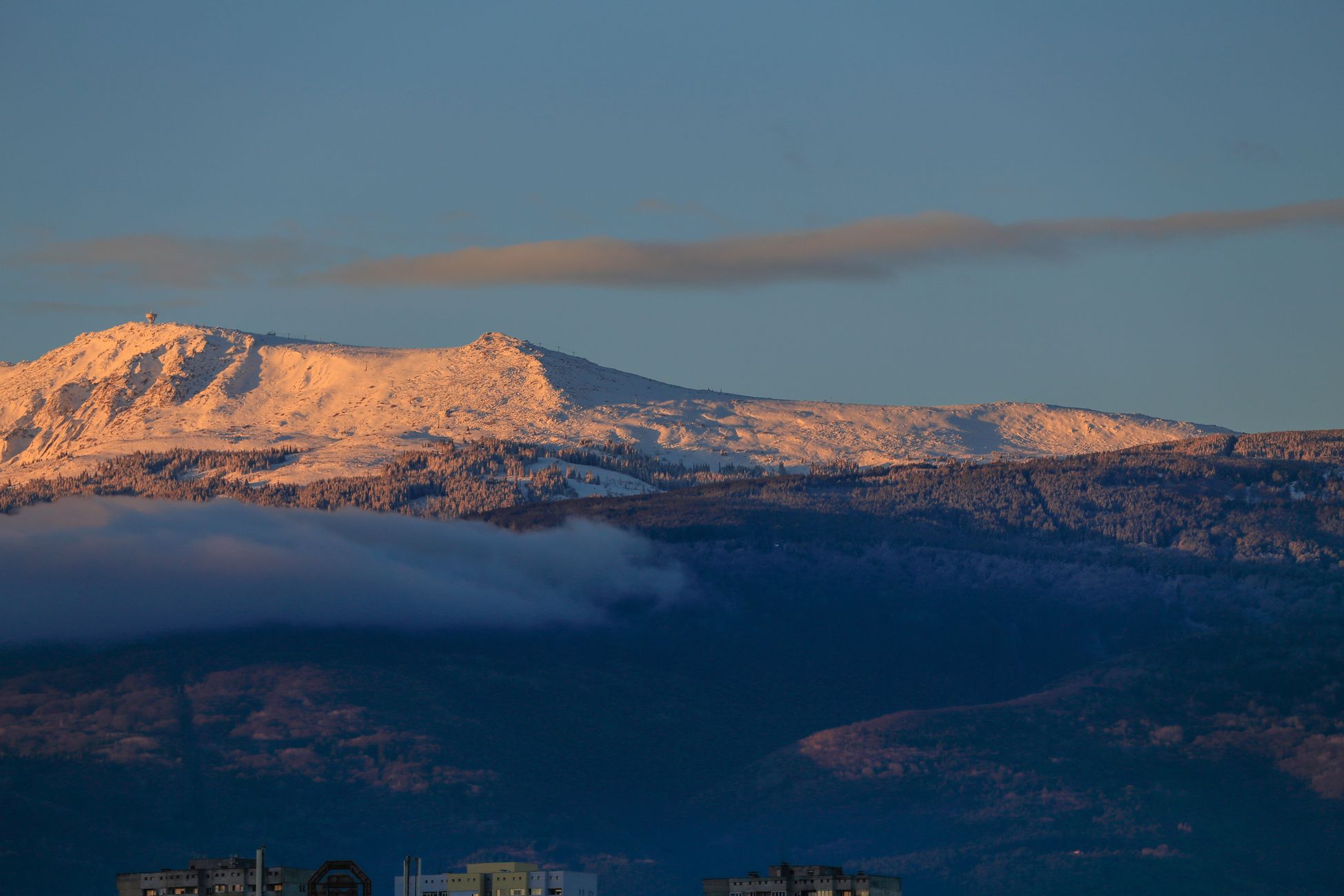
Why Vitosha works as a winter day trip
Vitosha rises to 2,290 metres less than 10 kilometres from the centre of Sofia. No other European capital puts a real snow mountain that close to its main square, and that is the whole argument for a winter day trip here. You sleep in the city, you climb the mountain, you are back for dinner.
The honest part comes next. The winter window is tighter than the marketing suggests. Reliable snow cover on the Aleko runs sits between roughly 5 January and 15 March, with the best conditions in the second half of January and the first three weeks of February. December is a gamble: some years the lifts open in the second week, some years not until the 27th. Early April usually still has snow at the top station, but the lower runs turn to slush by 11am.
There is no snowmaking to speak of, so a warm week in January can end the skiing entirely. The main Aleko chair also breaks down two or three days each season. This is not a resort you build a holiday around; it is a mountain you slot into a city trip. Book your ski day for the middle of your stay, not the last day, so a closure leaves you room to reshuffle.
Skiing at Aleko: the runs, the passes, the school
Aleko sits at 1,810 metres at the top of the lifts, with the ski area spreading out from the station. A day pass runs €24 to €29 depending on midweek versus weekend. Ski, boot and pole rental at the base is €16 to €21, with a helmet another €4. A two-hour group lesson through the ski school is €30 to €39, and English-speaking instructors are standard.
Beginners do fine here. The practice slopes near the top station are gentle and short, and a weekday beginner area is about half as crowded as a Saturday. Rent your gear at the mountain rather than in the city, and budget about €82 to €95 for a full beginner's day including a meal at the hut.
The limits are real, so plan around them. The lift infrastructure is old. If a pass stops working mid-morning because of wind or a breakdown, you can usually exchange it for another day within the season, though hotels will not refund you for a closed lift. A handful of small shops near the gondola base in Simeonovo also rent full sets at around €13 to €17 a day, with a smaller selection than at Aleko itself. Book ahead in January and February.
Check the mountain before you leave your hotel. The Vitosha lift page and ski.bg post morning updates by 8am. Two minutes on your phone saves a wasted morning.
Snowshoe walks from Aleko and below
Skiing is only half of a Vitosha winter. Above 1,500 metres the mountain holds snow from November to April, and the marked forest trails turn into snowshoe routes. The equipment is simple, and the quiet is the point: on a weekday in February you may see five other people all day.
The classic from the top is the trail toward Cherni Vrah, the 2,290-metre summit. From Aleko it is about 3.5 kilometres one way and a 480-metre climb, two hours up and ninety minutes down on a well-marked path. In winter this is a genuine mountain outing, not a stroll. The final approach is rock and wind, weather turns fast, and you want a shell layer, proper boots and someone in the group who has read the forecast.
Lower down, the Zlatnite Mostove area at 1,340 metres on the mountain's western flank is the better snowshoe day for most visitors. The stone river, a mile-long moraine of granite boulders, becomes a snowshoe route rather than a boulder-hop in winter, and there is a 6-kilometre loop through pine forest. Bus 63 from Ovcha Kupel reaches it on weekends; on weekdays a car or taxi is easier. One small restaurant serves mekitsa and grill for €4 to €7, and it is the only food on the route.
If you want the walk without the gear faff, the paths around Aleko itself and the road between Zlatnite Mostove and Aleko are the easiest introduction. Walk for an hour, turn around, drink coffee at the Aleko terrace at €3 and be down before the light goes. Sunset in late December is 4:50pm, so a winter walk here means starting early.
Getting there from the city
Two lifts run in winter and neither needs a car. The Simeonovo gondola leaves from the eastern edge of the city, is enclosed, runs in most weather and reaches Aleko at 1,800 metres in 25 minutes. It is the fastest way from a city bed onto the ridge. Bus 122 from Hladilnika terminal, at the end of metro line 2, reaches the gondola base in about 20 minutes and runs every 30 minutes on winter weekends. From central Sofia, door to snow is roughly 70 minutes.
The Dragalevtsi chairlift is the second option, slower but historically more consistent, and it closes in high wind. It climbs from the village to Bai Krastyo at 1,500 metres and connects to the Aleko piste system. Bus 64 runs from Hladilnika up to Dragalevtsi in about 20 minutes, and bus 66 continues past the village toward Aleko. The Knyazhevo chairlift, at €5, is the third, and it runs weekends only.
By taxi, the Simeonovo base is €10 to €14 from the centre, or €8 to €10 by Bolt, and ski bags are fine in both. Do not rent a car for a single Vitosha day: the road to the gondola is narrow, poorly gritted, and the parking at the base fills by 9am on Saturdays. Winter tyres are legally required from 15 November to 1 March, and most rental firms include them in winter.
One warning that matters more than any of the above. Both the gondola and the chairlift have had extended closures in past seasons for mechanical and ownership reasons. Check the current operating status before you book a ski-focused stay or get up early for one, and never assume a lift is running simply because it is January.
What to bring
Sofia in January is the coldest capital in the EU after Helsinki. Daytime highs sit at 0 to 4°C and nights drop to -6 to -10°C, with cold snaps pushing lower. It is a dry cold, which is bearable if you dress for it, but the mountain above 1,500 metres is another two or three degrees colder and much windier.
For the city: a winter coat rated to -10°C, waterproof boots, because Sofia pavements ice over, thermal base layers and gloves. Sunglasses matter more than visitors expect, since February sun on snow is intense.
For the ski day: rent everything except your base layers and gloves at the mountain. Hauling ski gear from home for one day is not worth the luggage. For a snowshoe day: waterproof boots with grip, a shell layer, a hat, water and lunch, because there is no café between Zlatnite Mostove and Aleko.
One more thing to check before you book, and this is specific to Sofia rather than to the mountain. Older buildings converted to guesthouses can be underheated. If you are coming in January, ask the hotel directly whether the room has proper heating, and ask skiers' hotels whether they have a heated ski-storage room or at least a covered garage. Not all do, and leaving wet gear in a wardrobe overnight is a mistake you make once.
Where to stay afterwards: Boyana, Dragalevtsi, Simeonovo
The three foothill villages on Vitosha's northern slope are the natural base for a winter mountain day, and each is about 9 to 10 kilometres from the centre. All three are former villages that Sofia grew around, all three are quieter and greener than the city, and none of them has a metro.
Boyana sits highest and is the pick if you also want sightseeing. The medieval Boyana Church, a UNESCO site with 13th-century frescoes, and the National History Museum are both in the village, five to ten minutes from most accommodation, and staying here means visiting either at 9am before the buses arrive. Boutique guesthouse rooms run €69 to €113 in shoulder season and €95 to €156 in summer, with small hotels at €82 to €121 for a double and villa rentals at €147 to €277 for three or four bedrooms. Bus 63 and bus 64 connect to Vitosha metro station on line M2. Boyana is the most expensive of the three, roughly 15 to 20% above Dragalevtsi.
Dragalevtsi is the skiing and hiking pick. The chairlift base is a ten-minute walk from the main village drag, so you can be on the Aleko piste in twenty minutes without touching a car when the lift runs. Guesthouse doubles sit at €48 to €69 with breakfast, and a whole two-bedroom house with garden and parking runs €95 to €139. A handful of boutique properties on the main road have pools and spas and touch €139 to €191. Bus 64 from Hladilnika reaches the village in about 20 minutes. If you do not ski and do not hike, the taxi back into town at midnight is the cost of staying here.
Simeonovo is the gondola pick and the cheapest of the three, undercutting Boyana by around 20%. From a room within walking distance of the gondola base you can be on skis at 1,800 metres within an hour of breakfast. Family guesthouse doubles are €43 to €65 with breakfast, boutique villa suites with pool and mountain view €95 to €139, and whole three- or four-bedroom houses €139 to €225. Bus 67 links the district to Hladilnika metro in 15 to 20 minutes. The trade is that Simeonovo has almost no restaurants and no walkable high street, so book it for a purpose, not by default.
If you would rather stay central and day-trip up, that works too. January outside the Christmas and New Year dates is the cheapest month of the year in Sofia, with the same central four-stars that charge €130 to €156 over the holidays dropping to €82 to €104, and guesthouses to €43 to €56. February holds slightly higher because of Valentine's weekend and ski demand from Serbian and Romanian visitors.
Whichever you choose, distance to the mountain is not the only thing to weigh. From Boyana, Dragalevtsi and Simeonovo you are 40 to 60 minutes from Alexander Nevsky Cathedral by bus and metro, and a taxi into town is €5 to €8 each way. Two return trips a day and you have spent the saving on the room. Match the base to the trip: for two nights, stay central and go up for one day; for four or more nights with the mountain in the plan, one of the three villages is the better sleep.
A realistic winter day, hour by hour
08:00. Check the lift status from your hotel room. Coffee in the city or in the village.
09:00. Bus 122 or bus 64 from Hladilnika, or a taxi to the Simeonovo gondola base. Twenty-five minutes up in the cabin, and you are at 1,800 metres by 10:15.
10:15. Collect rented skis and boots at the base, or set off on foot if it is a snowshoe day. Two hours on the slopes or on the trail to Cherni Vrah.
12:30. Lunch at one of the three restaurants at the gondola top, €9 mains, or soup and coffee at Aleko for less.
13:30. A second afternoon session, or the walk out toward Zlatnite Mostove if you came by the western side.
16:00. Last lift or gondola down. The light goes early in December and January, so do not leave this late.
17:00. Back in the city or in the foothills. A thermal bath, or dinner, or both. If you are staying in Boyana, Dragalevtsi or Simeonovo, one of the mehanas on the main road does traditional Bulgarian food at around €13 to €17 a head, and Vodenitsata in Boyana runs €19 to €28 mains with folk performances.
The day costs roughly €82 to €95 for a beginner skier including pass, rental, lesson and lunch, and nothing at all beyond transport if you are walking. That is the case for Vitosha in one line: a real snow mountain, an hour from your hotel, for the price of a dinner in most European capitals.
Questions, answered
Do I need a car for a Vitosha winter day?
No. Bus 122 from Hladilnika metro station reaches the Simeonovo gondola base in about 20 minutes, and bus 64 reaches Dragalevtsi, where the chairlift climbs to 1,500 metres. A taxi to the Simeonovo base is €10 to €14 from the centre. Renting a car for one mountain day is more trouble than it is worth.
When is the snow reliable on Vitosha?
Roughly 5 January to 15 March, with the best conditions in the second half of January and the first three weeks of February. There is no snowmaking, so a warm week can end the skiing. Book your ski day for the middle of your trip rather than the last day.
Can a beginner ski at Aleko?
Yes. The practice slopes near the top station are gentle and short, and two-hour group lessons run €30 to €39 with English-speaking instructors. Go on a weekday, when the beginner area is about half as busy as a Saturday.
What should I bring for a snowshoe day?
Waterproof boots with grip, a shell layer, a hat, gloves, water and lunch. Between Zlatnite Mostove and Aleko there is no café, and weather above 1,500 metres turns fast.
Which village should I stay in after a day on the mountain?
Dragalevtsi if the mountain is the point, because the chairlift base is a ten-minute walk from the village centre. Simeonovo if you want the gondola and the lowest rates. Boyana if you also want the medieval church and the National History Museum on your doorstep, at roughly 15 to 20% more.
Doing good is the business: every booking through Stay Sofia funds one verified tonne of carbon removal — same room, same price, no markup.
Start your search