Spiritual Sites
Hagia Sophia Church
The 6th-century basilica that gave the city its name, standing across the square from Alexander Nevsky.
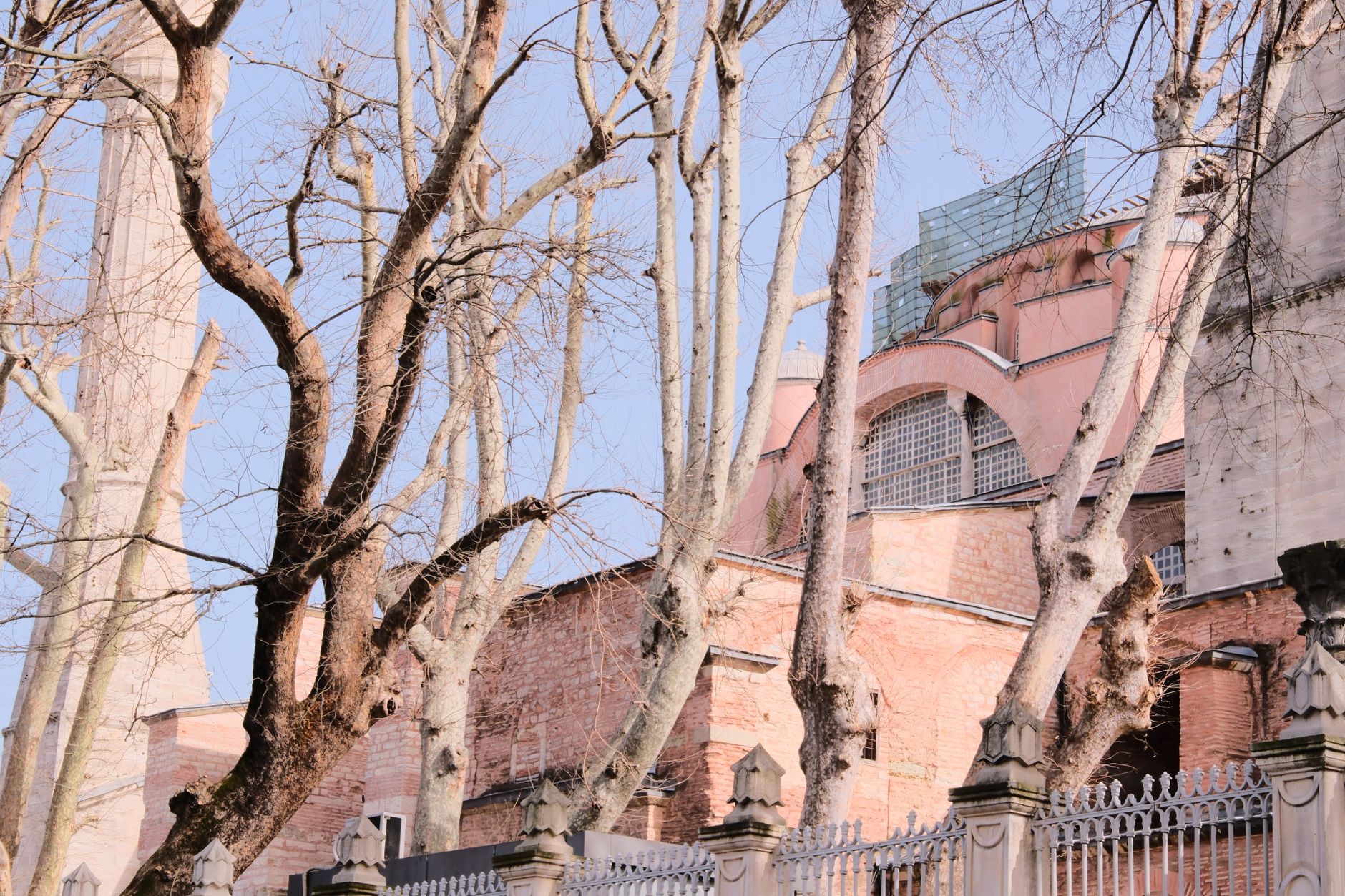
Sofia takes its name from this church, not the other way around. Hagia Sophia — Holy Wisdom — was built around 537 AD in the reign of Justinian, on the site of two earlier Christian basilicas and a Roman necropolis. The current red-brick building is the fifth church on the spot; it survived Ottoman conversion to a mosque, two 19th-century earthquakes that felled its minaret, and Communist neglect. It gave its name to the city in the 14th century, when locals began calling the whole town after the church rather than by its old name of Sredets.
The interior is austere compared to Alexander Nevsky across the square — bare brick, cross-vaulted ceilings, almost no decoration. The power is in the space and the age. Beneath the church is one of Sofia's best-kept secrets: a Roman and early Christian necropolis with 56 tombs, mosaic floors from four separate 4th- to 6th-century churches, and glass walkways over the excavated ground. Outside on the terrace, the tomb of the unknown soldier burns with an eternal flame, and Ivan Vazov — Bulgaria's national poet — is buried under a granite slab to the east.
Do the necropolis. Almost no tour group includes it and it is the more interesting half of the site. Buy the €3 ticket at the small booth to the left of the main entrance. Combine with Alexander Nevsky directly opposite for a one-two of Sofia's spiritual heart, or continue down Moskovska Street to the Russian Church five minutes west. Weekday mornings are peaceful; Saturday afternoons see many weddings in the church itself.
The visit runs in three parts and takes about an hour if you do all of them. Upstairs, the church itself is a cross-domed basilica with three naves, a narrow narthex and stone floors worn into dips; there is no iconostasis screen of the sort you get in a 19th-century Bulgarian church, just a modest altar area, a few icons on stands, and a candle table by the door where a beeswax taper costs a few cents. Give the walls a slow lap — the brickwork changes colour and coursing at least three times, marking the 6th-century core, later Ottoman patching and the 20th-century restoration. Then step out onto the terrace on the north side for the eternal flame and the medieval stone fragments laid out on the grass. Leave the crypt for last, because it takes the longest and you will want to come back up into daylight afterwards.
The necropolis entrance is a separate stair down beside the church, and the exhibition below is better presented than the free upper church suggests. Glass walkways run over excavated brick tombs, some still showing painted crosses and vine motifs on the plaster, and the mosaic pavements of the earlier basilicas sit at eye level in raked light. Bilingual Bulgarian and English panels explain the sequence of churches; there is no audio guide and you do not need one, because the labelling does the job. Budget 40 minutes if you read everything, 20 if you skim. It is cool and dry year-round, which makes it the right half of the site on a hot August afternoon or during a downpour. Photography without flash is fine; a tripod is not. Do not expect the crypt to be open on a Monday.
Getting here is short from anywhere central. Metro Line M1 and M4 both serve Sofia University St. Kliment Ohridski, and from the surface exit it is a flat five-minute walk northeast along Tsar Osvoboditel Boulevard past the Parliament to Alexander Nevsky Square; the church is on the square's west side. From Serdika, the interchange under the Largo, the walk is ten easy minutes along Todor Aleksandrov and Moskovska. A single Sofia Urban Mobility Centre ticket for metro, tram or bus is about €0.80, and a one-day all-lines pass is roughly €2.30, which pays off only if you are riding four or more times. Trams 20 and 22 stop near Vasil Levski Boulevard, a five-minute walk south. Driving is the worst option: the square has no visitor car park, blue-zone kerbside parking around Oborishte is about €1 an hour and enforced hard on weekdays.
Costs are small and there is no upsell to worry about. The church above ground is free and always has been; nobody will ask you for a donation, though there is a candle box. The necropolis is €3 for adults and €2 for students with ID, paid in cash or by card at the kiosk left of the main door, and children under seven go free. There is no combined ticket with Alexander Nevsky opposite — that church is also free to enter, with its own separate crypt museum charging around €4 for the icon collection. Private guided tours of Hagia Sophia sold on the square run €15 to €25 per person, which is five to eight times the entry fee for information already printed on the crypt panels. Skip them and read the boards. There is no cafe, shop or cloakroom on site.
Timing matters more here than price. The church opens daily at 7:00 and the first two hours belong to parishioners lighting candles — atmospheric, but the crypt is shut until 10:00, so arriving at dawn means two visits. The genuine quiet window is Tuesday to Friday, 10:00 to 12:00, when the tour coaches are still working the Nevsky side of the square. From about 13:00 the square fills, and Saturday from midday through late afternoon is wedding season: back-to-back Orthodox ceremonies, the nave full, and photography inside effectively off the table. Sunday morning liturgy is the same story. Seasonally, May to early June and September to October are best, with the terrace lawns green and the brick warm-toned in low sun. January and February are grim on the exposed square, though the crypt is unaffected by weather. Last crypt entry is around 16:30.
It suits anyone with an hour and an interest in layers of city — Roman tombs under Byzantine brick under a modern capital. Teenagers who yawn at icons usually engage with the glass-floor crypt because it is closer to an excavation than a museum. Families with buggies will struggle: the crypt is reached by stairs with no lift, and the walkways are narrow, so one adult waits above. Wheelchair users can enter the upper church at ground level from the terrace side, but the necropolis is not accessible. With only one hour before a train from Central Station, do the crypt and skip the interior; with one church-hour in Sofia overall, the existing advice stands — Alexander Nevsky and Boyana are the stronger pair.
Everything else worth doing is within ten minutes on foot. Alexander Nevsky Cathedral is directly opposite, 100 metres across the square, with the open-air antiques and icon market on its north flank. The National Gallery in the former royal palace and the Sofia Synagogue lie west along Moskovska and Ekzarh Yosif; the gilded Russian Church of St Nikolas is five minutes west on Tsar Osvoboditel, and the Ivan Vazov National Theatre with the City Garden is eight. Sofia University, the National Library and Borisova Gradina park are five to twelve minutes east. Hotels in walking range include Grand Hotel Sofia, Sense Hotel Sofia a Member of Design Hotels and Oborishte 63 Boutique Hotel, all inside ten minutes of the square. Fold the church into a morning that ends with lunch on Shishman Street, six minutes south.
The honest caveats: visitors who have seen the Hagia Sophia in Istanbul sometimes arrive expecting scale and gold, and this is a modest brick basilica the size of a parish church, with no mosaics on its walls and no dome interior to speak of. The upper church takes 20 minutes and can feel thin if you skip the crypt — which is precisely why the crypt is the point, and why arriving before 10:00 or on a Monday wastes the trip. The eternal flame and Vazov's grave take three minutes between them. Nobody queues here in any meaningful sense; the only crowding is wedding parties spilling out of the narthex. Dress modestly enough to enter an active Orthodox church, and expect no toilets, no left luggage and no seating beyond a few chairs by the north wall.
Hours & entry
Church free · Necropolis crypt €3
Daily 7:00-18:00 · Necropolis Tue-Sun 10:00-17:00 · Necropolis closed Mon
What to see
4th-6th century mosaic floors of earlier basilicas — Underground necropolis, glass walkways
Tomb of the Unknown Soldier with eternal flame — Terrace, north side of the church
Grave of poet Ivan Vazov — East side of the exterior, marked granite slab
Tips from the ground
The necropolis ticket booth is a small stand-alone kiosk — easily missed. It is left of the main door.
Weekdays 10:00-12:00 are the quietest times; weekends fill with Bulgarian Orthodox weddings.
Skip if you have only one church-hour in Sofia; do Alexander Nevsky and Boyana instead.
Questions, answered
How much is entry?
The church is free. The underground necropolis is €3 for adults, €2 for students. Children under seven enter the crypt free, and the kiosk left of the main door takes cash and cards. There is no combined ticket with Alexander Nevsky opposite, which is itself free to enter with a separate crypt museum at about €4. Ignore the guides selling tours of the site on the square at €15 to €25 per person; the crypt panels carry the same material in English.
Are there free days for the necropolis?
No dedicated free days, but the church above is free at all times. That means the upper basilica, the terrace with the eternal flame at the Tomb of the Unknown Soldier and Ivan Vazov's grave on the east side cost nothing on any day of the year, including Mondays when the crypt is closed. At €3, the necropolis is among the cheapest paid sites in central Sofia, and it is the half most visitors regret missing rather than the half they resent paying for.
How long should I plan?
20 minutes for the church, 40 minutes for the necropolis — about an hour combined. Skim-readers get through the crypt in 20 minutes; anyone reading every bilingual panel over the 56 tombs and the mosaic pavements should allow the full 40. Add three minutes for the eternal flame and Vazov's grave outside. If you are pairing it with Alexander Nevsky, 100 metres across the square, block out two and a half hours for both and lunch afterwards.
When is it closed?
The church opens daily. The necropolis is closed on Mondays. Church hours run 7:00 to 18:00 every day; the crypt is Tuesday to Sunday, 10:00 to 17:00, with last entry around 16:30. Arriving before 10:00 gets you the free upper church only. Saturday from midday and Sunday morning bring Orthodox weddings and liturgy, when the nave is full and photography inside is impractical — Tuesday to Friday between 10:00 and 12:00 is the reliably quiet window.
Do I need a reservation?
No booking is required for either. Walk up, pay at the kiosk for the crypt and go down; there is no timed entry, no online ticket and no queue worth the name outside wedding hours. Group tours occasionally fill the narrow glass walkways below for five or ten minutes, so if you arrive behind twenty people, wait upstairs rather than shuffle. Nothing here needs advance planning beyond checking that it is not a Monday.
Which metro stop is closest?
Sofia University St. Kliment Ohridski on Line M1, five minutes walk. Serdika is an easy ten-minute walk. Lines M1 and M4 both call at Sofia University; from the exit, head northeast along Tsar Osvoboditel past the Parliament to Alexander Nevsky Square. A single ticket valid on metro, tram and bus is about €0.80 and a one-day all-lines pass roughly €2.30. Trams 20 and 22 stop five minutes south on Vasil Levski. Driving is pointless — no visitor car park, and blue-zone kerbside parking runs about €1 an hour.
Doing good is the business: every booking through Stay Sofia funds one verified tonne of carbon removal — same room, same price, no markup.
Start your search