Springs Spas
Central Mineral Springs & Fountains
Sofia sits on 40 mineral springs — the public taps outside the old baths run 40°C water free, all day, every day.
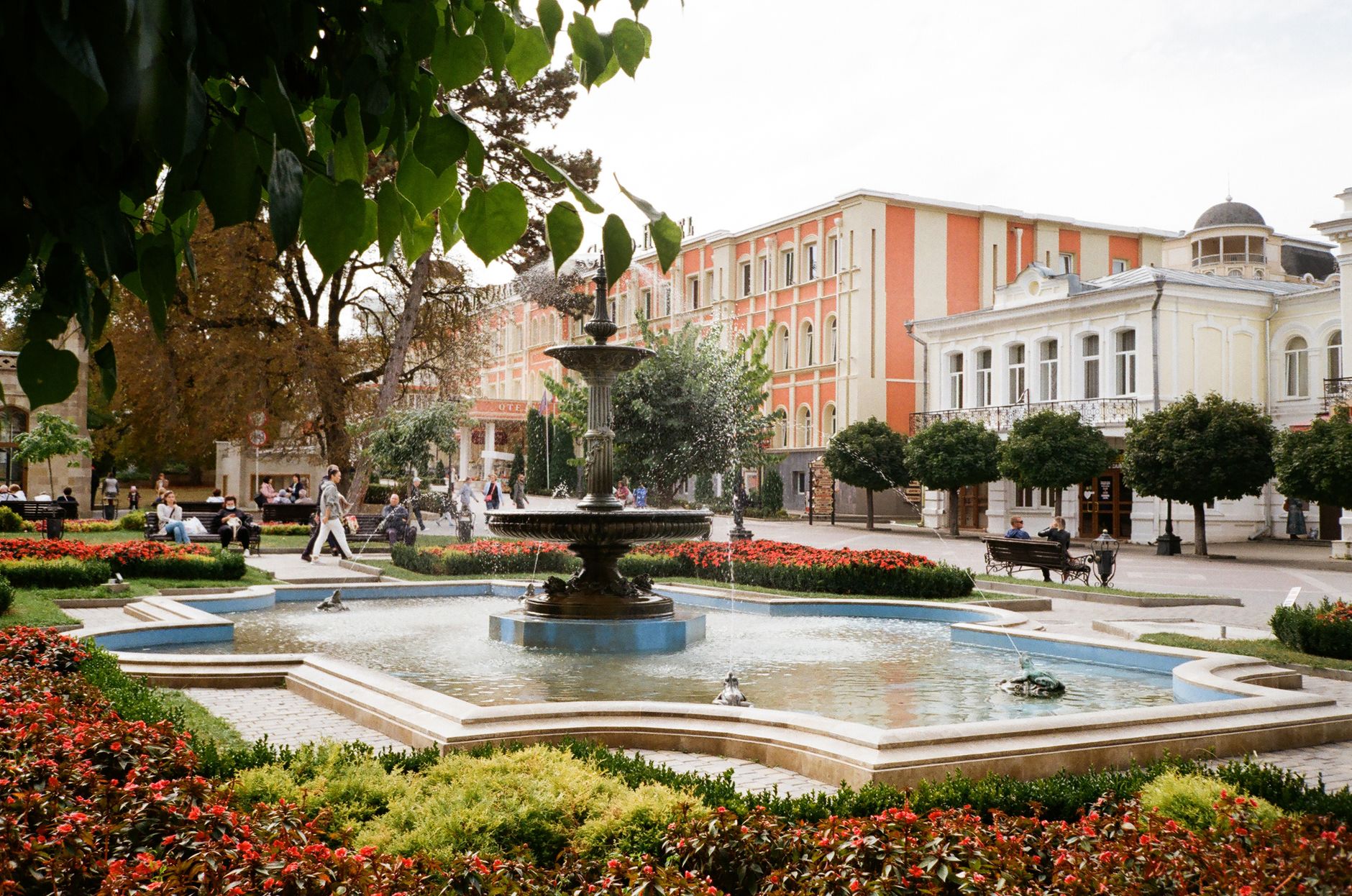
Sofia's very existence is due to its thermal springs — the Thracians founded a settlement here to bathe in them, the Romans built Serdica around them, and Ottoman Sofia was famous across the Balkans for its baths. Forty mineral springs still bubble up under the city, and eight are used publicly. The largest emerges next to the Central Mineral Baths building at 46°C, and the small park in front of the baths has a wall of stone taps running continuously, night and day, free for anyone to drink or fill bottles from. The square itself is called Banski Square — Bath Square — and the yellow-and-ochre building behind it was raised between 1904 and 1913 to designs by Petko Momchilov and Friedrich Grünanger, its facade patterned with imported ceramic tile in a Vienna Secession reading of Byzantine ornament. Come for the taps; the building is the backdrop.
The water is safe, mildly mineralised (calcium, magnesium, fluoride, low sulphur), and comes out around 40°C — hot to the touch. Sofians queue with 5-litre bottles to fill up; you will see the same faces every morning. There is no formal bathhouse operating in central Sofia today — the 1913 baths are the History Museum — but the drinking fountains, and hot pools at the outdoor Bankya and Gorna Banya suburbs (bus 60 or a short taxi), keep the tradition alive. The mineral water is also piped to the Halite market and a few older cafes. It is alkaline, very low in dissolved solids, and carries a faint sulphur note on the first mouthful that vanishes once the water has cooled in a bottle for twenty minutes. Fill up, walk on, and drink it later rather than gulping it scalding at the spout.
The simplest, most local, most photographable free experience in central Sofia. Bring an empty bottle, fill it up, and drink where locals have been drinking for 2,000 years. Combine with the Sofia History Museum in the baths behind, and the mosque directly across the street. Steam rises visibly on winter mornings and the taps become genuinely atmospheric. Do not drink if you have iron or heart medication concerns; check the tap-side sign for mineral content.
There is no route and no sequence here. You arrive at a flat paved square with benches, a shallow ornamental pool laid out when the museum opened in 2015, and a low stone screen with a row of spouts pouring non-stop into a trough. Etiquette is unwritten but real: regulars filling six or eight canisters will wave you ahead if you hold a single bottle, so hold it visibly and you will wait seconds rather than minutes. Inside the building, the Regional History Museum of Sofia runs chronologically from Serdica through Ottoman Sofia to the 1940s, with the royal family's ceremonial carriages, city maps, and stretches of the original marble and tilework of the bathing halls left exposed. Budget 20 minutes for the taps and a full hour if you go in — the carriage hall and the preserved bath interiors are the parts worth your time.
Getting here is the easy part. Metro Serdika, the M1/M2 interchange, sits three minutes away: take the exit signed for the Central Market Hall, cross Knyaginya Maria Luisa Boulevard at the lights, and the square opens on your right. A single ride is about €0.80 and a 24-hour ticket about €2, worth it only if you are riding four times or more. Trams running the length of Maria Luisa stop within a minute of the taps. On foot it is eight minutes from Sveta Nedelya church, six from the St George Rotunda, and fifteen from Alexander Nevski Cathedral. From Central Railway Station it is a 10-12 minute walk south along Maria Luisa, or one metro stop. Trains from Sofia Airport run through Serdika without a change in roughly 25 minutes for the same €0.80 fare. Do not drive: kerbside blue-zone parking is about €1 an hour with a two-hour cap.
Costs barely exist. The taps take no money, have no attendant and no donation box, and you may fill as many litres as you can carry. The only ticket in the complex is the Sofia History Museum inside the old bathhouse, roughly €3 for an adult and about €1 for students and children — cheap enough that a rainy hour there is an easy yes. Arriving empty-handed, a five-litre plastic canister costs around €1.50 in the Halite basement supermarket two minutes away, or bring a reusable bottle and spend nothing at all. Skip any paid city tour that advertises the baths as a highlight; the tip-based Free Sofia Tour already walks past this square daily and a €5-10 tip covers it. A half-day built around the springs, the mosque, the market hall and the museum comes to under €10 per person.
Timing changes the place completely. Between about 07:00 and 09:00 the regulars arrive with crates of containers and, in winter, steam pours off the trough thickly enough to hide the far side of the square — that is the photograph, and it is gone by 09:30. Mid-morning to mid-afternoon the taps are quiet and you will have them to yourself. Mondays the museum is closed while the fountains run as always, so save the indoor half for Tuesday to Sunday, 10:00-18:00. November to February is the season; July and August are the weakest, with no visible steam, no shade on the square and 40°C water that nobody wants. In deep winter the paving around the trough ices over from splashed water, so wear something with grip. Friday around midday the pavement opposite fills for prayers at Banya Bashi Mosque — come an hour either side.
It suits almost everyone for a short visit. The square is flat, step-free paving with no kerbs to fight, so wheelchairs and prams manage it easily, and there is nothing to queue for. Families do well, with one warning: the water leaves the spout hot enough to hurt small hands, so fill the bottle yourself. Teenagers will give it five minutes and be more interested in Halite. A rainy afternoon is genuinely well served — taps, museum, market hall and the Sofia Synagogue all sit inside a five-minute radius. With a one-hour gap before a train, this is one of the few Sofia sights that works, being a 10-12 minute walk from Central Station. Skip it entirely if you came to bathe: the 1913 halls hold no water, there is no spa, no pool and no changing room anywhere in the centre, and the nearest soakable thermal water is out at Bankya or Gorna Banya.
Fold it into a tight half-day. Banya Bashi Mosque is one minute across the boulevard and open to respectful visitors outside prayer times; Halite, the 1911 Central Market Hall, is two minutes away with bakery counters and a cheap basement supermarket for lunch; the Sofia Synagogue, one of Europe's largest Sephardic synagogues, is five minutes west; the sprawling Zhenski Pazar produce market is eight minutes north. Going the other way, the Serdica archaeological complex and the St George Rotunda are six to eight minutes south, the Largo and the hourly guard change at the Presidency eight. Guests at Hotel Via Serdika or Central Hotel Sofia can make the taps a genuine morning ritual, both being roughly ten minutes on foot. One last honesty: after about 22:00 the square is dimly lit and largely empty, and the streets north toward the station are scruffy — the water is unchanged, but come in daylight.
Hours & entry
Always free
Fountains open 24 h · Bathhouse (as museum) Tue-Sun 10:00-18:00
What to see
Wall of continuously flowing public taps — Small park directly north of the Mineral Baths building
Steam rising on cold mornings — Around the tap wall in winter, best before 8:00
1913 ceramic-tile facade of the old bathhouse — Directly across the park from the fountains
Tips from the ground
Bring a plastic or stainless steel bottle — the water is 40°C and glass can crack.
Best atmosphere on winter mornings before 08:00 when steam is thickest.
The tap at the far right runs slightly cooler and is easier to drink from directly.
Questions, answered
Any charge?
No. The public taps are free, forever. There is no ticket, no attendant and no donation box, and you may fill as many litres as you can carry away. The only paid element on the site is the Sofia History Museum inside the old bathhouse behind the square, roughly €3 for an adult and about €1 for students and children. Nobody sells cups or bottles at the taps, so bring your own; a five-litre canister costs about €1.50 in the Halite basement supermarket, two minutes away.
Free times?
24 hours a day. The spouts are never switched off — the flow is continuous, unmetered and unstaffed, so 03:00 works as well as 15:00 in mechanical terms. Practically, aim for 07:00-08:00 in winter, when the regulars arrive and the steam is at its thickest, or mid-morning if you want the trough to yourself. After about 22:00 the square is dimly lit and empty; the water is fine but the setting is not one to linger in alone. Museum hours are separate: Tue-Sun 10:00-18:00.
How long?
10-30 minutes to fill bottles and look around. Add 10-15 minutes if you arrive around 07:30 behind someone filling eight canisters, though regulars usually wave a single-bottle visitor ahead. Add a full hour for the Regional History Museum of Sofia in the bathhouse, where the royal carriages and the exposed original tilework are the parts worth the time. Strung together with Banya Bashi Mosque one minute away and Halite market two minutes away, the whole cluster fills a comfortable 90 minutes.
Closed?
Never — the taps run continuously. There is nothing to close: no gate, no opening hour and no seasonal shutdown, and the water leaves the ground at 46°C year-round. The museum in the bathhouse is the exception, shut on Mondays and open Tue-Sun 10:00-18:00, so plan the indoor half around that. In January and February splashed water freezes on the paving around the trough, which is the only real reason to hesitate; wear shoes with grip and step carefully.
Booking?
None. Nothing here is ticketed or reservable, and the museum next door is a straightforward walk-in at roughly €3. If you want context, the tip-based Free Sofia Tour passes this square daily and needs no booking — just turn up at the advertised meeting point and tip €5-10 at the end. Skip any paid tour sold on the strength of the baths; you would be paying several times the museum entry for a stop you can make in twenty free minutes. Come after 09:00 to avoid the canister rush.
Metro?
Serdika (M1/M2), three minutes north. Use the exit signed for the Central Market Hall, cross Knyaginya Maria Luisa Boulevard at the lights and the square is immediately on your right. A single ride costs about €0.80 and a 24-hour ticket about €2. Trams running along Maria Luisa stop a minute away, Central Railway Station is one metro stop or a 10-12 minute walk, and metro trains from Sofia Airport reach Serdika without a change in roughly 25 minutes. Driving is pointless: blue-zone kerbside parking runs about €1 an hour with a two-hour limit.
Doing good is the business: every booking through Stay Sofia funds one verified tonne of carbon removal — same room, same price, no markup.
Start your search